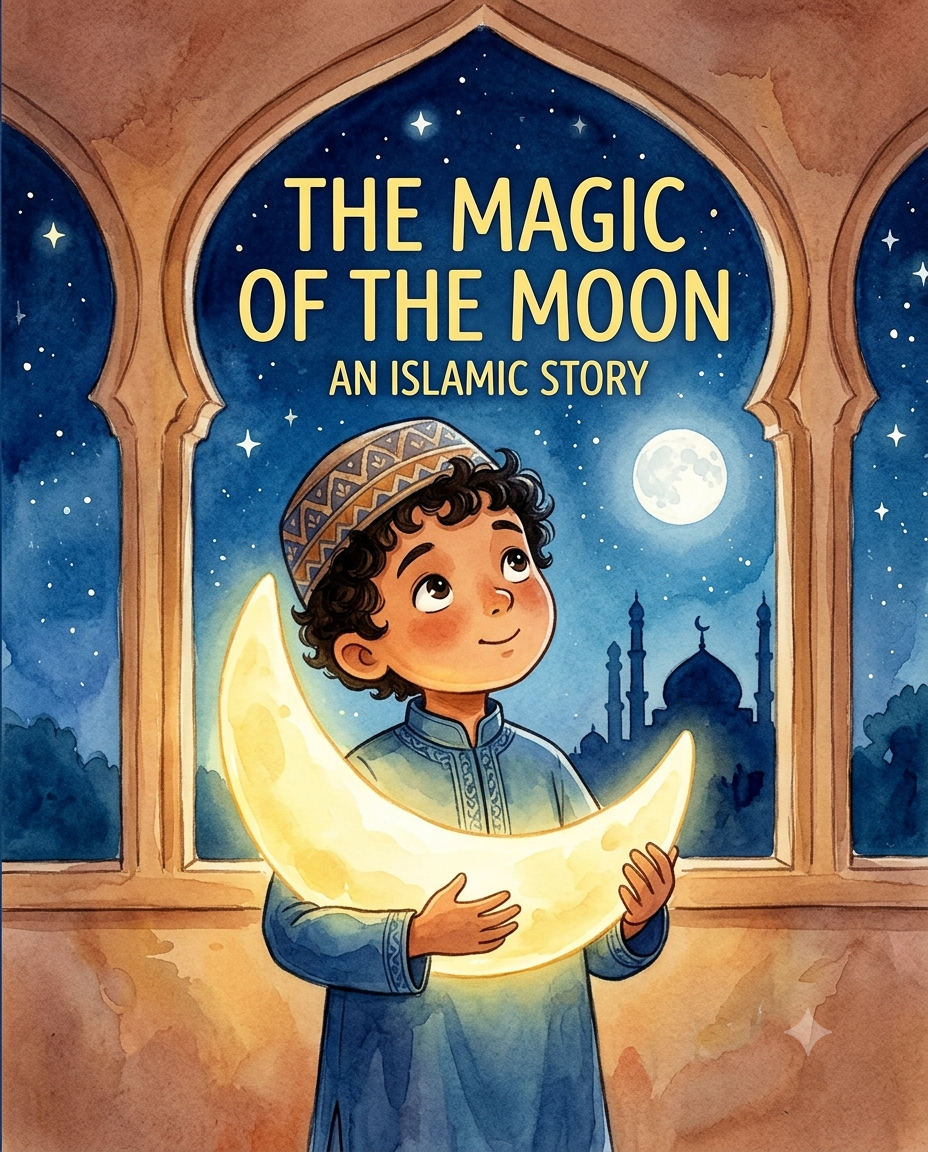
Once upon a time, in a small village surrounded by rolling hills and ancient olive trees, lived a curious and kind-hearted boy named Omar. Omar loved everything about his village—the smell of freshly baked bread from the baker, the sound of the muezzin's call to prayer echoing from the mosque, and the tales told by the village elders. But what Omar loved most of all was the night sky.
Every evening, after the Maghrib prayer, Omar would rush up to the flat roof of his house. He'd lie on his back and stare up at the stars, which sparkled like precious gems. And there, big and bright, was the moon. To Omar, the moon looked like a smiling face watching over the world.
Omar's favorite companion during these evening watches was his wise grandfather, Grandpa Ibrahim. Grandpa Ibrahim knew so many stories about the stars, the prophets, and the wonders of the world. He always had a twinkle in his eye and a warm smile that made Omar feel safe and cozy.
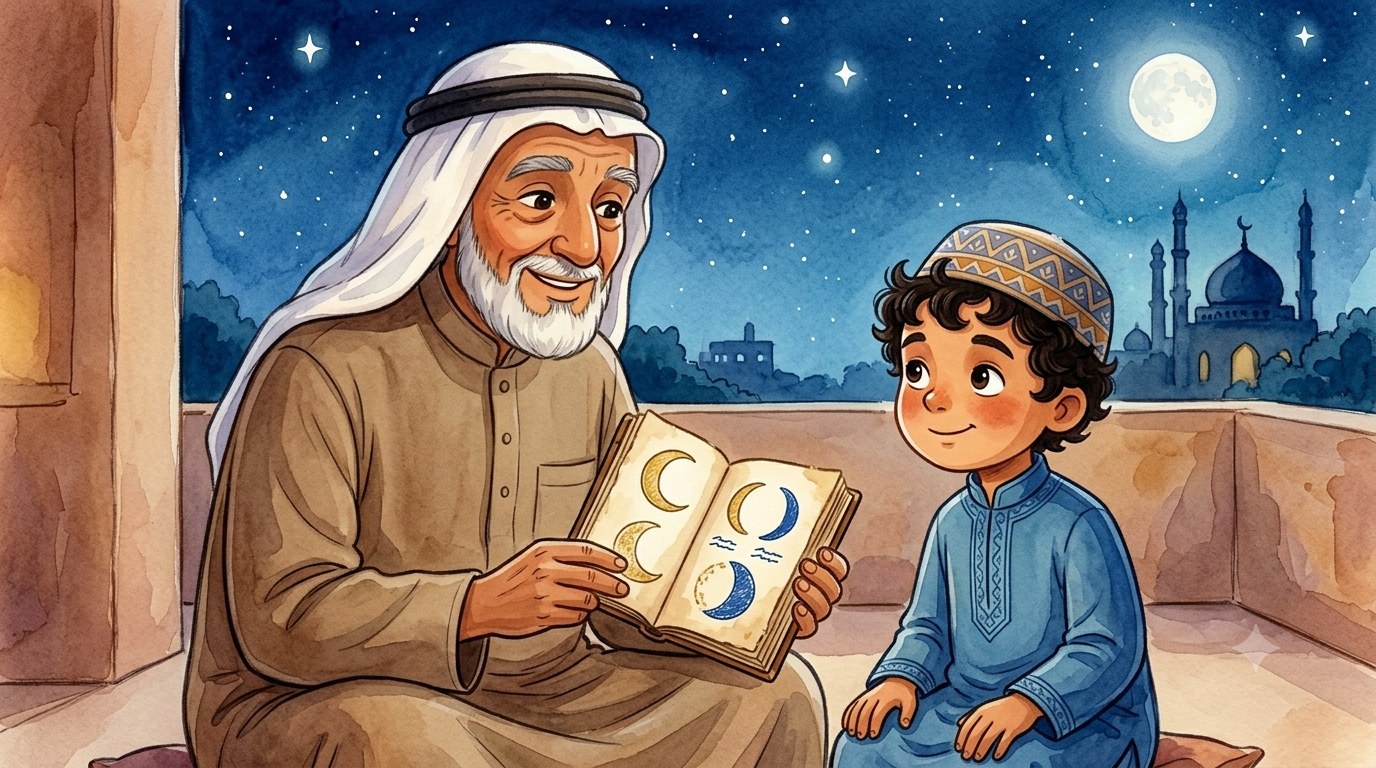
"Grandpa," Omar asked one night, pointing to the crescent moon, "why does the moon change its shape? Sometimes it's a perfect circle, like a delicious flatbread, and other times it's like a sliver, like a piece of a date?"
Grandpa Ibrahim chuckled softly and stroked his silver beard. "Ah, Omar, that is one of the many signs of Allah’s creation. The moon is like a giant clock for us, showing us the passage of time."
"A clock?" Omar was puzzled.
"Yes! Look at this month," Grandpa Ibrahim said, pulling out a small, weathered notebook where he kept his notes. "We just finished Ramadan, the month of fasting. How did we know when it began? Because we saw the new crescent moon, right here!" He pointed to a small drawing in his notebook.
This notebook was special. It was filled with beautiful calligraphy and illustrations Grandpa had drawn over the years. On the page he showed Omar, there was a detailed drawing of the sky with the different phases of the moon, all in gold and blue ink.
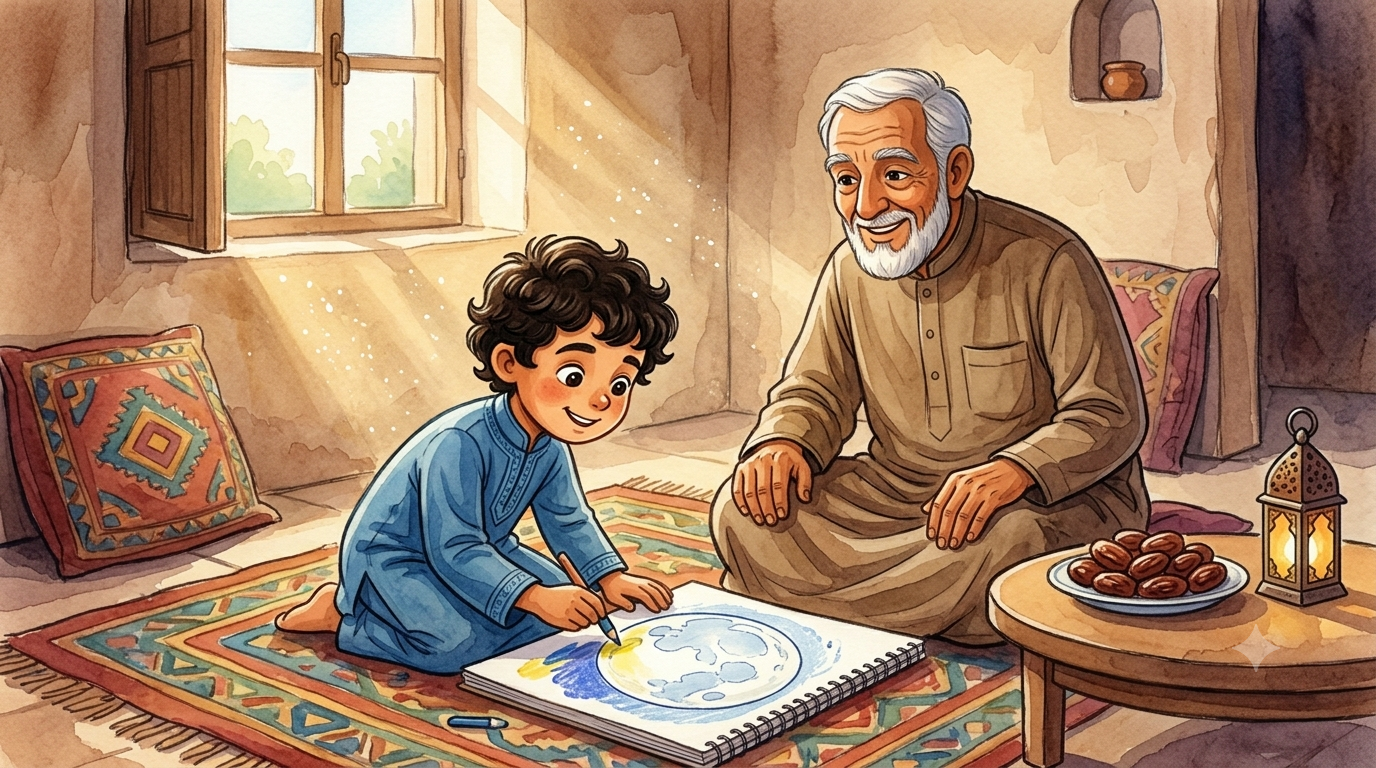
"And now, we're watching the moon grow bigger each night," Grandpa Ibrahim continued, "until it becomes a full circle. That will be the time of Eid al-Fitr, a day of celebration, new clothes, and delicious sweets!"
Omar's eyes widened. Eid! He loved Eid. He loved getting special gifts and eating yummy food with his family and friends. "So the moon is like a happy messenger, telling us Eid is coming!"
"Exactly, Omar," Grandpa Ibrahim said, patting his grandson’s shoulder. "The moon reminds us of the beautiful gifts Allah gives us—the special times of the year and the chance to gather and show gratitude."
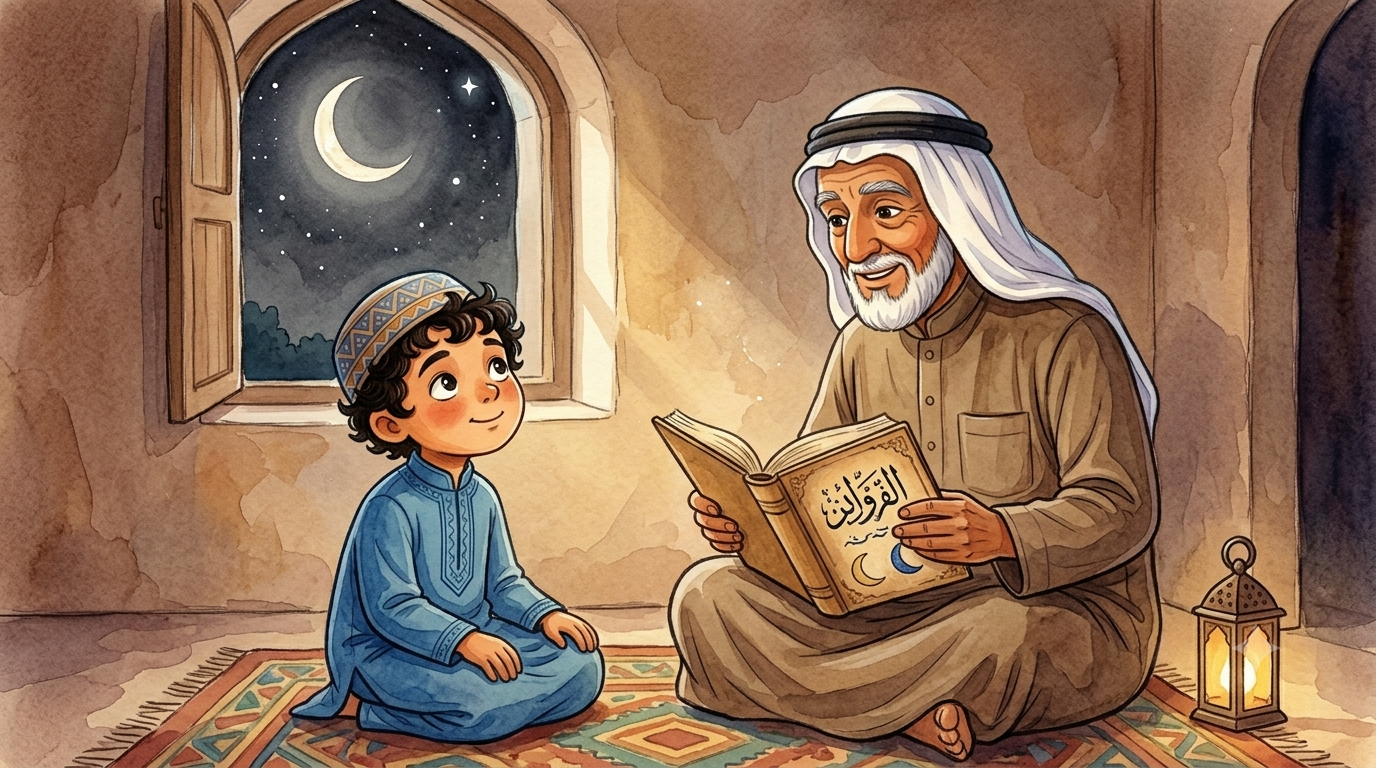
Grandpa Ibrahim opened a book he was holding, its leather cover worn from many hours of reading. The title was "Tales of the Prophets and the Moon." He began to read. "And then, in the city of Makkah, when people were confused and needed a sign, the Prophet (peace be upon him) pointed towards the full moon, and by Allah's will, the moon split in two! This was a powerful sign that left everyone in awe of Allah's might."
The story was incredible! Omar could almost see the split moon in his mind, and his heart filled with wonder. He closed his eyes and whispered, "SubhanAllah," meaning 'Glory be to Allah.'
"Just like the moon, Omar," Grandpa Ibrahim said gently, closing the book, "even if we cannot see all of something, or if it seems different, Allah’s mercy and creation are always there, full and complete, just like the beautiful, round full moon."
From that day on, Omar didn't just see the moon as a shining ball in the sky. He saw it as a magical teacher, a messenger of special holidays, and a sign of Allah’s wonderful power. He was grateful for the moon and grateful for his wise grandpa who taught him its story.
And so, every night, Omar would look up at the moon and whisper a little prayer of gratitude, knowing that no matter the shape, the moon was always watching over him and his village, a beautiful sign of Allah’s creation.
The End.